
Built With Is Not Built On
A label that survives the longest at companies that shipped no model at all.
What "AI-Native" Meant In Every Room I Was In
I spent last month running agentic AI workshops across India. The university stops were mostly in Gujarat, a western state where the buildings told me education is a state priority. The corporate stops were mostly down south, in the cities where the global capability centers cluster and the client calls run on US time.
By the third corporate visit, I had a pattern I could predict before I walked in. I would ask what people were doing with AI and get confident answers. Copilot in Outlook. Some in Word. Occasionally in Excel, more rarely in PowerPoint. Then I would ask about the engineering side, and the energy in the room changed. Everyone was using Claude Code, GitHub Copilot, and coding agents daily. Most of them told me, unprompted, that they were AI-native.
So I asked the follow-up. Does the product you ship call an LLM API at any point in its runtime?
I mostly heard a no.
This is not a Gujarat story or a South India story. These were companies with the deepest Western client exposure in the country, ahead of the median on adoption if anything, which is what makes the pattern worth writing down rather than filing under expected.
The Rooms Explain The Gap Before The Companies Do
The campus stops went the same way every time, and the reaction was never excitement. It was relief. Finally, someone was explaining what an agent actually is and how it differs from a chatbot. Every student in those rooms had used ChatGPT and Claude. Almost daily. None had been shown, by anyone whose job it is to teach it, what you actually build with it.
I understood why after I ran a faculty development session at one of the higher-ranked institutions on the trip, a place that puts thousands of graduates into the market every year. Partway through, one of the faculty said something that took nerve. The department had heard all the terms. Context engineering, RLHF, DPO and PPO, fine-tuning, agentic workflows. Until that morning, nobody in the room had known what any of them meant in practice.
That is not a confession. It is a description of a large-scale supply problem. The vocabulary reaches a department through conference talks and vendor decks. What never reaches it is a worked example, or anyone who actually built the thing and can say what broke when they did.
I checked whether this was an India-specific gap, and it is not. The global undergraduate standard, CS2023, issued by ACM, the IEEE Computer Society, and AAAI, gets revised roughly once a decade. ACM's own material states the goal was a curriculum meant to last until 2033, then concedes in the same breath that holding a standard steady that long has become increasingly difficult. Finalized before any of this arrived, with no scheduled mechanism to revisit it for another seven years. The Computing Research Association ran its own catch-up process, 32 roundtables and more than 200 experts, publishing in September 2025 on how to expand AI curricula, precisely because the formal standard does not cover the ground.
So the faculty in that Gujarat classroom were not behind their counterparts in California. They were on the same ten-year clock everyone is on. The difference was that somebody in the room said it out loud, and the students who inherit that gap are the same ones who walk into the corporate rooms I visited next, calling a coding assistant an AI-native strategy because nobody taught them the difference.
The Follow-Up Question Nobody Had Been Asked Before
The existing argument about "AI-native" is an argument about degree, and venture investors have spent two years and more sharpening a test for it. CRV's version is the cleanest one I have come across. Their argument is that the model layer is the part you can replace, and that whatever value survives that replacement is the only value you actually own. Founders can swap the model layer, they write, but they cannot swap the accumulated domain intelligence. Put a user interface on a foundation model API and nothing about that arrangement generates traction on its own any more.
The ACM SIGOPS crowd makes the same complaint less politely, pointing out that every product announcement now calls itself AI-native and that asking five people what the term means gets five different answers.
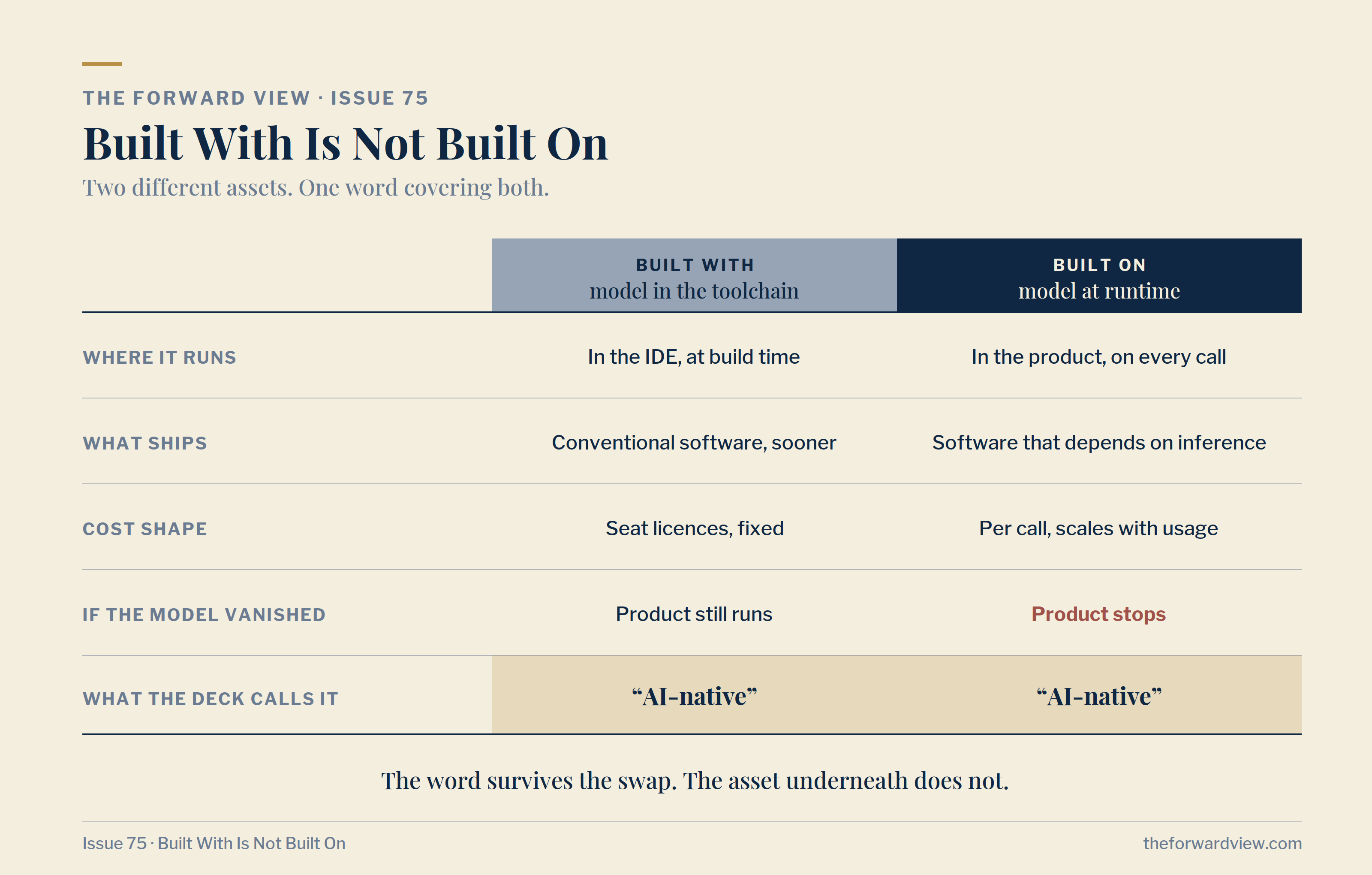
Both of those arguments are about how much model sits inside the product. What I sat across from in those rooms falls outside the argument entirely. There was no model in the product to swap out in the first place. The claim rested on one fact: the engineers used an agent to write the code faster.
That is a real gain, and I am not interested in being sniffy about teams shipping sooner with Claude Code or Copilot. But shipping conventional software faster is a different asset than shipping software that runs on inference, and both had been folded into one word that turns up in the same board deck, the same diligence questionnaire, the same client pitch.
Meanwhile the models were in these organizations. Just not in the product.
Where The Models Actually Were
India has roughly 100 million weekly ChatGPT users, by Sam Altman's own account, published the day before February's AI Impact Summit, second only to the United States and with the largest student population of any country using the product. OpenAI opened a Delhi office last August, built a sub-five-dollar tier for the market, then made that tier free for a year. OpenAI looked at its second-largest user base and concluded it would not pay.
I asked people, plainly, what happens to the material they paste into these tools. Client documents. Internal drafts. Code. The answers were honest and unembarrassed, because nobody had ever suggested it was a question worth asking. It had not occurred to them.
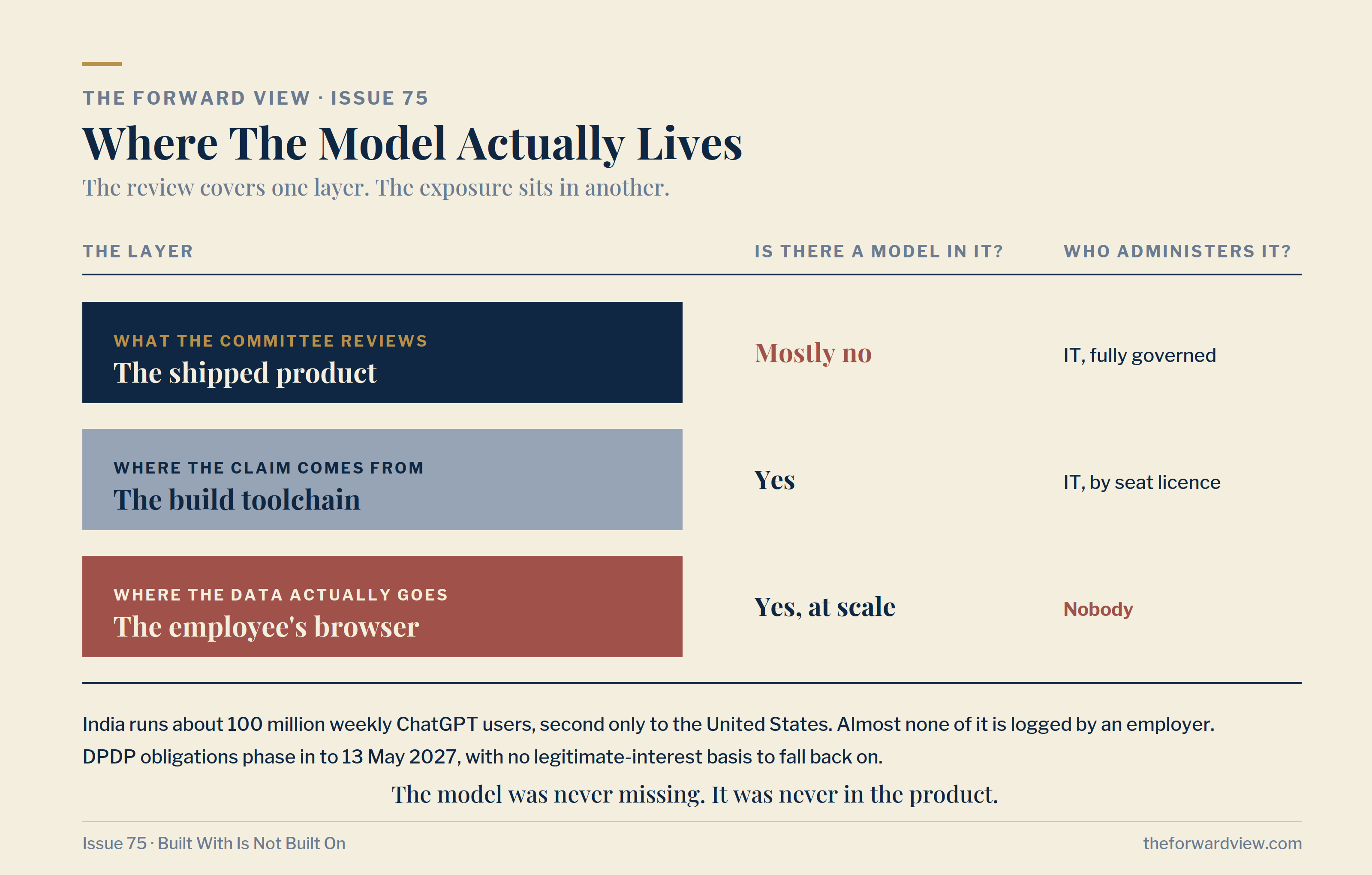
That is the actual shape of AI exposure inside most of these companies right now. An unmeasured volume of client and company material moving through consumer accounts that IT does not administer, under terms nobody read.
One CIO told me: his team had counted seats on the enterprise tier of a major chatbot provider the year before and treated the small number that came back as containment. When I asked how he would find out how many people were using the free consumer version on their personal phones during work hours, he had no answer.
There was one moment on the trip that showed me the other side of this coin. We brought dublabs.ai, an AI Guru product that translates across Indian languages with lip-sync, into several of these sessions, mostly as a demonstration of what a model actually embedded in a product looks like. It was the thing people wanted to talk about afterward at every single venue. A country with 22 scheduled languages has a problem the incumbent frontier models handle badly, and Sarvam's response, a 30B and a 105B model open-sourced under Apache 2.0 in March, trained on IndiaAI Mission compute, is sitting there for anyone who wants to build on it instead of just chat through it.
The Test That Settles It
The CRV test is useful precisely because it is binary. You swap the model, keep the value, or lose it. But the version I would add, after three weeks of asking it directly, is upstream of that one: is there a model to swap in the first place?
Most governance frameworks I have seen assume the answer is yes. Model risk policies, AI inventories, deployment review gates, all pointed at the product, because that is where an AI deployment is supposed to live. In the companies I visited, that surface contains no model at all. The real exposure sits somewhere the framework was never built to reach, because it doesn't look like an AI deployment. It looks like somebody using a website on their own laptop, on their own time, with their own login.
A governance committee reviewing the shipped product in one of these companies would find nothing to flag. The actual risk is one browser tab away from the review, and most of the risk and compliance people I asked about it had never tried answering the upstream question, not out of carelessness, but because their job description started at the product boundary and nobody had told them the boundary was wrong.
What This Means In Three Years
Push the timeline out to 2029, and I would expect the label itself to have been repriced. Either "AI-native" acquires a testable definition, in which case most of the companies using it today quietly stop, or it goes commercially inert the way "cloud-enabled" did once every product ran on a server somewhere. My hunch is the second outcome, and whoever writes the diligence checklist that survives a dispute over it gets to define what replaces the word.
The workforce layer, the consumer accounts nobody administers, gets pulled inside the perimeter too, and it will not be cheap when it happens. The organizations that get there first will not have done it out of foresight. They will have done it because a regulator, a client, or an insurer asked a question they could not answer.
The language gap is the one I would watch most closely. Once open-weight local models are genuinely competitive on the languages the frontier labs serve badly, procurement stops being a question of which vendor and starts being a question of which architecture, and based on what I watched happen in those rooms, that shift is closer to eighteen months out than five years.
What A Decider Should Do This Week
If you sit on a board, the fiduciary question is not whether the company uses AI. It is whether the AI inventory reviews actually cover where the exposure lives. Ask for the consumer account count alongside the licensed-seat count at the next meeting, and ask why they have not been the same line item until now.
If you run a PE portfolio, treat "AI-native" as a claim to underwrite, not a label to accept. Ask each portfolio company whether its shipped product calls a model at runtime. If the answer takes a paragraph instead of a sentence, the valuation premium attached to that label needs a second look before the next mark.
If you are a CTO or a buyer, ask your own team the same question you'd ask a vendor. A yes or no, not a paragraph. Then count the consumer AI accounts across the org that the company itself does not administer. Not the licences purchased, the accounts that exist. In most places the second number is a large multiple of the first, and only the first shows up in any report anyone has seen.
Either way, split the AI line item in two. Tools that help your people build, and models that run inside what you actually sell. Different vendor dependency, different cost structure, different exit risk, almost certainly commingled in whatever you are tracking today.
If you advise regulators or sit inside a compliance function, stop treating the AI inventory as a list of vendor contracts. It is closer to a list of all the places company data can leave the building, and most of those exits have no contract attached to them at all.
And if you ship into a market the frontier vendors serve badly, get open-weight local models on this quarter's evaluation list rather than next year's budget cycle.
The Bottom Line
The AI in most enterprises is not where the board thinks it is. It is not in the product, whatever the deck says. It is in the workforce, on accounts nobody administers, handling material the company owes duties on. Close that gap first. Most of what looks like an AI strategy problem turns out to be an account inventory problem.
P.S. India's DPDP Rules were gazetted on 13 November 2025, with obligations phasing in over eighteen months to 13 May 2027. Penalties run to 250 crore rupees and stack per violation, and unlike GDPR there is no legitimate-interest basis to fall back on. Ask whoever owns this at your company one question: if a regulator asked for a log of every AI-assisted decision from the last 90 days, how fast could you actually produce it? The honest answer will tell you your firm's honest story.