
What the Plant Floor Knows About Robots
The process industries spent 70 years learning to govern autonomous control of complex physical environments. Physical AI has not imported the discipline yet.
I was standing in the control room of a paper mill, and the sound was the first thing that registered. Not the machine itself, which ran at a low, continuous roar somewhere behind the wall of glass. It was quiet inside the room. Six screens, a dozen live readings each, and one operator watching all of them at once, the way an air traffic controller watches a sector he has memorized.
The paper was moving through the dryer section at something like 1500 feet a minute. Every few seconds, the system made a small adjustment on its own. Steam pressure on this screen, tension on the next one. A fraction of a degree on a roll temperature. Hundreds of these decisions a shift, none of them requiring a human hand.
Then a moisture reading on the sheet drifted outside its band. Not dramatically. A number that moved and kept moving. The system did not just correct and move on. It flagged the drift and lit up the operator's screen, but it kept its adjustment inside a range it was not permitted to exceed on its own. The operator looked at it for eleven seconds, then made a call and logged the reason before he touched anything. Ninety seconds after that, because the correction crossed a threshold written into the system decades before he took his first shift, his shift supervisor was standing next to him. Not because the mill was in danger. Because the manual said that above a certain threshold, a second set of eyes is not optional.
Nobody in that room described any of this as heroic. It was Tuesday. It was a procedure.
This is what governed autonomy looks like when someone builds it deliberately. It is not new. It has been the operating standard in the process industries for forty years. And it is missing from almost every physical AI deployment I have reviewed in 2026.
What Boards Are Actually Using to Govern This
Physical AI deployment approvals are happening right now, and most of the boards signing off on them are reaching for a risk framework that was never built for this. The NIST AI Risk Management Framework, released in January 2023, is the document I see cited most often in board materials. It was written for machine learning models and generative systems. It has nothing to say about a closed loop of perception and physical action, with reasoning mediating between them, operating in the same room as your employees.
ISO/IEC 42001, the AI management system standard published in December 2023, is governance-adjacent in the same way. Useful for structuring an AI program. Silent on the physical AI question.
Underneath both of those sits an even thinner layer. Humanoid deployment in US workplaces is currently governed by OSHA's General Duty Clause, Section 5(a)(1), a catch-all that applies precisely because no specific standard exists yet. ISO 10218 covers industrial robots bolted to a factory floor, not humanoids with adaptive AI making judgment calls in open space. The standard built specifically for that gap, ISO 25785-1, which covers dynamically stable robots that require active control to remain upright, had its working group draft published in May 2025 and remains under committee review. It is not close to publication.
The regulatory perimeter is closing faster than the standards are maturing. EU AI Act high-risk obligations take effect August 2, 2026. The Colorado AI Act became effective June 30, 2026, two days before this issue goes out.
I keep hearing the same question from boards, and it is almost always some version of: is there a human in the loop? That was the right question three years ago. It is the wrong question now.
None of that is wrong. It is just insufficient. And the frameworks the reader needs already exist in a body of work almost none of the boards approving physical AI deployments in 2026 have read.
The Human-in-the-Loop Instinct
The conventional take is that governance for physical AI comes down to keeping a person in the decision chain. As I argued previously in Human in the Loop Is Not a Control, that instinct was correct for early digital AI. It caught bad content moderation calls. It kept reinforcement learning from human feedback from drifting. And when a wrong answer sat on a screen in an LLM deployment, someone could edit it before it did anything.
Having a human in the loop is not a bad instinct. It just belongs to an earlier stage of the problem.
The process industries stopped asking whether there was a human in the loop somewhere around the 1970s, because the question stopped being useful once the system was making hundreds of decisions a shift faster than any operator could review each one. Human in the loop is a first-mile question. The physical AI conversation is now in mile ten, and the industries that have been running autonomous control for seventy years already know what the question sounds like at that distance.
What Forty Years of Process Safety Actually Built
Governed autonomous control has a specific shape, and it is worth naming precisely because most physical AI deployments in 2026 do not have it. A controller makes rapid decisions inside a complex physical environment, under constraints it cannot override on its own. Its authority is bounded. Escalation paths are defined in advance, so a human enters the chain exactly when a reading crosses a line someone drew before the shift started. The system cannot rewrite its own tuning. Intervention rights are layered across the operator, the shift supervisor, and the plant manager, each with a distinct scope of authority. Every manual override gets logged with a reason. Failure modes are designed and tested before they happen, not discovered after.
This is the vocabulary that a paper mill operator or a refinery engineer speaks without thinking about it. It is also the vocabulary that MillMind builds directly into the industrial AI systems it runs inside operations like JMC Paper Tech. Not as a pitch. As proof, the discipline is sitting on the ground in 2026 for anyone paying attention to it.
The framework stack that codified this discipline sits behind a set of numbers most boards can learn in one meeting. IEC 61508 is the umbrella functional safety standard. IEC 61511 is the process industry adaptation, covering chemical, oil and gas, pharmaceuticals, and pulp and paper. ANSI/ISA-84.00.01 is the US version, and OSHA identified it in 2000 as good engineering practice for safety instrumented systems. Sibling standards cover nuclear applications and automotive, with a separate track for machinery. At the center of all of them sits the Safety Integrity Level, a four-level rating scheme. A board does not need the underlying math. It needs to know that "what SIL does this deployment operate at" is a legible, answerable question.
The analytical tools a board should recognize by name are equally accessible. HAZOP is the structured walkthrough that identifies what can go wrong in a process. Layer of Protection Analysis, developed by the Center for Chemical Process Safety and first published as a guideline in 2001, is the method for testing whether existing safeguards are actually sufficient. Bow Tie analysis maps the causes of an incident on one side, the consequences on the other, and draws the barriers between them. CCPS Risk-Based Process Safety, published in 2007, organizes all of it into four pillars: commit to process safety, understand hazards and risk, manage risk, and learn from experience, with 20 elements underneath.
The two incidents that made skipping this expensive are worth naming, because forty years of discipline did not appear from nowhere. On December 3, 1984, a methyl isocyanate release at a Union Carbide pesticide plant in Bhopal killed an official count of 3,787 people, with estimates running considerably higher. The Center for Chemical Process Safety was chartered within five months. OSHA promulgated the Process Safety Management standard, 29 CFR 1910.119, on June 1, 1992. Fourteen elements, and it still anchors every US process safety compliance program running today.
On July 6, 1988, an explosion on the Piper Alpha platform in the North Sea killed 167 of the 229 people on board. The Cullen Inquiry ran for two years and issued 106 recommendations. The UK adopted the Offshore Installations Safety Case Regulations in 1992, requiring operators to demonstrate control of major hazards under the ALARP principle. Australia, Malaysia, and Norway have since adopted the same regime.
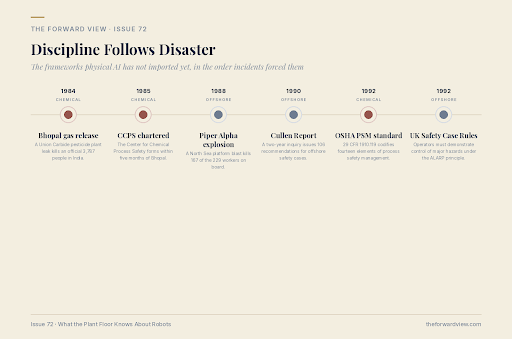
Discipline follows disaster: the frameworks physical AI has not imported yet, in the order incidents forced them.
Forty years of discipline is not theoretical. It was written in the aftermath of specific incidents that killed thousands of people. Boards approving physical AI deployments in 2026 without this framework are betting the aftermath will not repeat.
Where this lands on an actual deployment is the payoff. A humanoid working a factory floor needs a SIL rating or its functional equivalent. A robotaxi fleet warrants a Bow Tie analysis on the failure mode of an incorrect action at intersection speed. An embodied agent in a warehouse needs a LOPA showing independent protection layers, because a single failure mode with no redundant barrier is the exact shape of the incident that eventually happens.
That is not a hypothetical shape. In May, federal investigators opened an inquiry into Avride, Uber's robotaxi partner in Dallas, after 16 crashes across Dallas and Austin between December 2025 and March 2026. NHTSA's language was precise: the performance of the automated driving system "may indicate inappropriate assertiveness and insufficient competence to execute these driving behaviors in a safe manner." That is a description of a system operating without a bounded envelope. It is the exact failure mode a Bow Tie analysis is built to catch before regulators have to write it down after the fact.
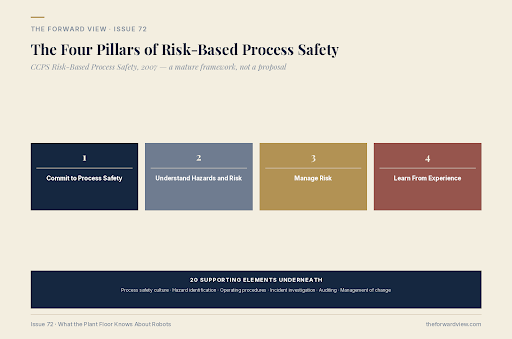
CCPS Risk-Based Process Safety, 2007 — a mature framework, not a proposal.
None of this requires reinventing the discipline. It requires importing the vocabulary and letting frameworks that already exist do the work they were built for. The vocabulary and the frameworks are already there. So are the tools. Someone imports them, or the regulatory system imports them retroactively after the incident, which makes it expensive to skip.
What This Means by 2029
Push the timeline out to 2029. Regulatory frameworks converge on process safety discipline for physical AI. NHTSA, OSHA, FDA, and EPA guidance leans increasingly on the ISA-84 and IEC 61511 lineage, because it is the only mature vocabulary available to borrow. ISO 25785-1 lands in final form well past its working group draft. Insurance underwriters reprice physical AI exposure with more granularity, and the carriers that already built actuarial tables against known process safety frameworks set the terms for everyone else.
The Caremark doctrine expands to cover physical AI oversight. This is the beat that changes who is on the hook, and it is worth sitting with. Marchand v. Barnhill established in 2019 that boards face heightened oversight duty for risks that are mission-critical to the business, a case that grew out of Blue Bell Creameries' failure to oversee food safety after a listeria outbreak killed three people. In re Boeing Co. Derivative Litigation applied that same reasoning to airplane safety, finding Boeing's board had failed to build a reporting system for what the court called a vital and mission-critical safety function. As of this May, no Delaware court has yet ruled on a Caremark claim built specifically around a board's failure to oversee AI risk. The machinery is not untested, though. Delaware courts sustained Caremark oversight claims in September 2025 in the Teligent case on almost identical reasoning, an alleged failure to build board-level monitoring for a risk that was core to the business. Physical AI deployments in industrial and transportation environments will meet that mission-critical threshold in a growing number of cases, and consumer-facing deployments will follow. The first ruling that applies Caremark directly to a physical AI failure has not been written yet. The doctrine that will produce it already has.
As I covered in The Physical AI Era, the deployment numbers behind all of this are no longer projections. The exposure behind them is no longer hypothetical either.
The 2030 question is whether regulatory convergence happens through incidents or through anticipation. Enterprises preparing for both compound differently from enterprises betting on one.
What a Decider Should Do
If you sit on a board, ask your management team what SIL rating, or functional equivalent, the company's most consequential physical AI deployment operates at. If the answer is that the company does not use that framework, you have found the vocabulary gap in the room. Book a session with a functional safety engineer at your next quarterly meeting. The engineer costs less than a single board member's insurance premium.
If you run a PE portfolio, require a Layer of Protection Analysis on any physical AI deployment above a threshold you set, unit count, capex, or exposure to public-facing operations. The methodology has been in active use for twenty-five years, and the specialist community that runs LOPAs is deep. Add it to your standard operational diligence checklist by the fourth quarter.
If you are a GC or head of compliance, pull the CCPS Risk-Based Process Safety elements and map your current AI governance program against them. The four pillars are the right organizing frame for physical AI at the board level. Your product safety, occupational health, and trade compliance functions already speak this language for other purposes. Bring them into the AI governance conversation before the next board cycle.
If you are a CTO or head of architecture, run a Bow Tie analysis on one current physical AI deployment in the next 90 days. Pick the deployment with the highest failure consequence, not the largest capex. Bow Tie is the fastest way to see where the barriers are, where they are not, and what the incident pathway looks like, drawn on a single page.
The Bottom Line
The plant floor knows something about robots that the boardroom has not yet learned. It knows how to run a controller that makes hundreds of autonomous decisions a shift, inside an envelope the controller cannot violate on its own, with escalation logic that catches the moment a reading moves outside its expected range, with a paper trail that would survive an inquiry.
It knows this because the alternative was written in the aftermath of Bhopal and Piper Alpha, and neither is a story anyone in the process industries wants to relearn.
Physical AI is not a new problem in the sense that matters. It is an old problem with a new surface area. The frameworks are already on the shelf. The vocabulary is already in the operating manuals.
The plant floor knows. Someone in the board room has to ask.
P.S. Pick one physical AI deployment in your organization or your portfolio. Find whoever sits closest to it and ask one question: if this system acts incorrectly on a Tuesday afternoon, which layer of protection catches it first, and what is the SIL rating on that layer? If the person cannot answer, or the honest answer is that there is no layer, the discipline gap is now on the record in your own notes. The next 24 months will start to price that gap. The next 36 months will start to litigate it.