
The Permission Problem
The latest moat in AI is power. And the fix for this isn't coming from any single capital or any single state.
A few weeks ago, I was tracking a Meta data center rising out of the desert outside El Paso. The goal was to understand the gap between the capacity companies announce and the capacity they can actually energize. What you are reading right now starts closer to my home in New Jersey.
Last week, more than sixty environmental, labor, and community groups asked Governor Mikie Sherrill of New Jersey to use emergency powers to halt approval and construction of any new data center drawing 20 megawatts or more. Her own executive orders already name data center demand as a significant driver of what she calls an electricity affordability emergency in the state.
That same week, the South Jersey town of Millville voted to ban data centers outright, killing a proposed 1.4-gigawatt facility that would have been the largest in state history.
One detail from the coalition's letter to the Governor was that a single mid-size 20-megawatt data center draws as much electricity as every home in Montclair, her hometown, a town of nearly 40,000.
But this is not really a New Jersey story.
The map is bigger than New Jersey
The buildout running in Texas is running into resistance in places where the politics on almost every other question barely overlap. In the first six weeks of 2026, more than 300 data center bills were filed across 30-plus state legislatures. 27 states are actively considering bills aimed at the biggest power users. At least 18 would set up separate pricing tiers so their costs don't get passed to ordinary households. New York, South Dakota, and Oklahoma all have bills moving that would pause new construction entirely.
Virginia, the world's densest data center market, adopted a new pricing tier through its state utility regulator, requiring data centers above 25 megawatts to cover at least 85 percent of the grid costs they create, starting January 2027, with the legislature layering further cost-shifting bills on top. Georgia has a bipartisan bill that prohibits utilities from passing data center power costs on to anyone else. Colorado is requiring large operators to build or contract for their own dedicated power.
Red states and blue states. Places competing for data center investment and places that have already received it. The thing being built and the people who have to live next to it are now in open conflict on a national scale, with no national plan.
Underneath it all is a load curve the grid was not designed to absorb. Goldman Sachs expects US data center power consumption to more than double, from about 31 gigawatts in 2025 to 66 gigawatts in 2027, lifting data centers' share of the country's peak summer power from roughly 4 percent to 8.5 percent in two years. A generational load increase in 24 months, into a grid that takes longer than that to add a single major transmission line.
The NIMBY read
The conventional take treats all of this as a NIMBY reflex that has slowed housing, transmission, and wind farms for decades. Locals complain about noise, water, and views. Developers wait them out or move to a friendlier jurisdiction. Projects get built eventually.
Communities do object to large industrial neighbors. Some of the opposition is reflexive. Capital can usually find a state that wants the tax base. But reading the current wave as NIMBY misses what changed.
The fight is no longer mainly about where a data center sits. It is about who pays for the power it needs. A local nuisance has become a structural cost-allocation problem that follows the project everywhere it goes.
Who actually pays for the buildout
When a data center the size of a small city plugs into the grid, somebody has to build the generation and transmission to serve it. The question that decides everything: who pays for that buildout? Does the company drawing the power, or does everyone else on the same grid?
So far, it has mostly been everyone else.
The regional grid covering 13 states from Illinois to Virginia, plus Washington DC (the one most people in the mid-Atlantic and Midwest are plugged into), runs a wholesale auction every year to line up enough power for the future and pay generators to keep capacity on standby. Between the 2024 auction and the most recent one, that price went from $29 per megawatt-day to $329, an elevenfold increase that hit the legal cap. The grid's own market monitor attributed the jump largely to data center demand. That single move translates to roughly $9.3 billion in added costs spread across about 65 million households and businesses in one year. In Washington DC, the typical home's electricity bill went up $21 a month.
In Pennsylvania, utility shutoffs rose 21 percent in a single year. Generation rates had pushed some bills up 10 to 20 percent, and households at the margin started missing payments. Regulators are now processing a rate case explicitly designed to wall off residential customers from data center costs.
That is what it looks like when grid costs get spread across everyone, including people who cannot absorb the increase. It is also the political event that turns a regulatory technicality into a statehouse priority.
Washington has noticed. On March 4 2026, the White House convened seven of the largest hyperscalers and AI companies (Amazon, Google, Meta, Microsoft, OpenAI, Oracle, and xAI) to sign the Ratepayer Protection Pledge, a voluntary promise that their data centers' energy needs would not raise household electricity costs. The federal energy regulator has an active proceeding on how giant new power users plug into the grid, with a decision expected by June. The Department of Energy has proposed rules for power plants built right next to data centers. Senator Tom Cotton of Arkansas introduced a bill that would let fully off-grid data centers operate outside federal energy rules entirely. The House Republican policy framework on AI calls on Congress to make the White House pledge legally binding.
None of it has slowed the state-level wave.
State policymakers, including in red states usually aligned with the President, have not pulled back. The Pledge has no enforcement mechanism, so signing it costs a company nothing if it later changes its mind.
The federal energy regulator sets rules at the wholesale level, the prices utilities pay each other, but not at the retail level where voters open their bills. Federal rules mostly apply to the very largest projects, over 100 megawatts. The state and local fights now run all the way down to facilities a tenth of that size.
The two conversations are happening in different rooms.
This is where AI infrastructure stops being a technology story and becomes a regulatory governance story. The expertise that matters is not GPUs or cooling design. It is how utilities set their prices, how those prices get reviewed by state regulators, how the costs of running the grid get divided among different kinds of customers, and the century-old understanding that a utility serves all its customers on comparable terms. That understanding was not written for a single customer who arrives needing a gigawatt and changes the price everyone else pays.
Regulators are rewriting it in real time, in fifty different places, with the federal government calling for one direction and most of the states moving in another.
Once those costs stop getting spread across everyone else, the economics of the buildout change at the root. A project that pencils out when ratepayers absorb the grid upgrades looks very different when the developer carries them.
That is what turns power from a line item into the moat.
The operators who saw this early are already off the grid
Meta's El Paso campus is leaning on a dedicated 366-megawatt on-site gas plant to energize its first phase, because the public grid cannot serve the load on its timeline. Oracle's Project Jupiter went further, generating all of its own power on site with no connection to the public grid at all. What looked like a workaround a year ago is becoming a design principle: if you cannot get power from the grid fast enough, and increasingly you cannot, you bring your own.
Bringing your own power, which usually means natural gas, collides directly with the environmental objections that drove the community resistance in the first place. A company that solves its grid-access problem with on-site fossil generation has solved a scheduling problem and bought itself a permitting and reputational one.
The permission problem does not disappear when you leave the grid. It changes shape.
What this means for 2029
Push the clock to 2029 and the patchwork either resolves or it metastasizes. There is no third option.
This cannot be fixed at the state level. State legislatures can protect their own ratepayers, and they will. But a state-by-state solution produces 50 incompatible answers and pushes capacity into whichever jurisdiction has the loosest rules at the moment. That is exactly what created the political backlash in the first place. The current model rewards arbitrage over discipline.
It also cannot be fixed in Washington alone. Federal policy can set permitting, designate strategic infrastructure, and push voluntary pledges, but it cannot dictate utility prices to state regulators. It has not persuaded state legislators on either side of the aisle to stand down. The federal levers are real but partial. The state levers are decisive on the question that actually matters to voters: what arrives in the mailbox each month.
Resolution, if it comes, requires coordination across three centers of decision that rarely sit at the same table.
Washington has to do more than convene. The federal energy regulator's June ruling has to actually decide who pays for what when a giant new user plugs in, not just clarify procedure. Congress has to give the Ratepayer Protection Pledge teeth, or replace it with a federal rule that says large users carry their own infrastructure costs, while leaving room for states to keep protecting their own households.
Wall Street has to start underwriting these projects the way it has long underwritten regulated utilities and power plants, with political risk and the chance of rule changes priced in from the start. A capital structure built on grid costs that are getting handed back to the developer state by state is mispriced today. It will keep being mispriced until the people writing the debt and equity checks treat the political risk as the financial risk it has become.
Silicon Valley has to do more than sign a pledge. The operators who can get their sites approved over the next five years will be the ones that actually internalize the cost of their own power, through on-site generation, contracted dedicated supply, or directly funding the grid upgrades. Those who treat the Pledge as a press release and wait for Washington to override the states will keep losing county votes and statehouse fights. The capital tied up in those losses will not come back.
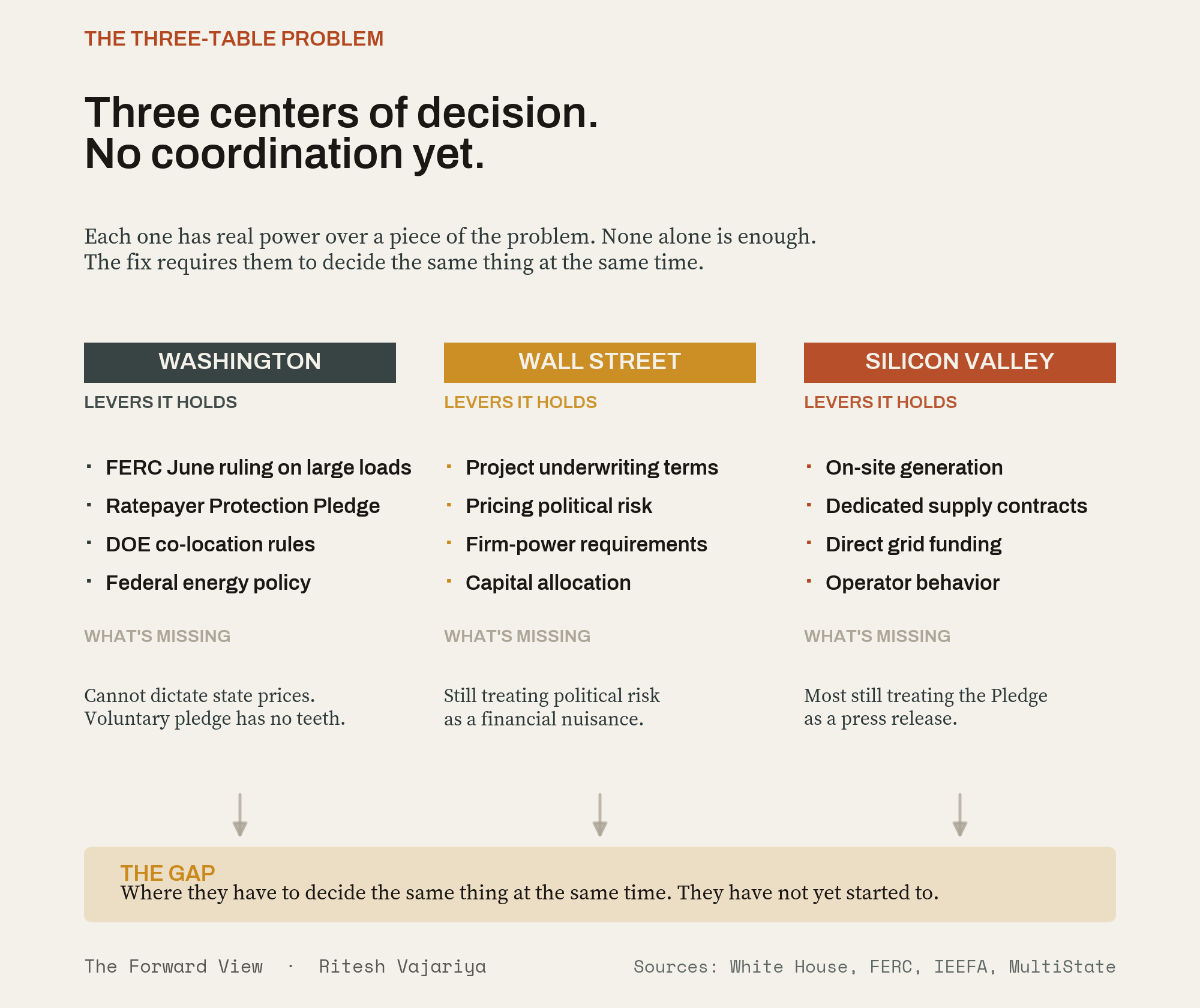
The three actor classes and the lever each one controls. None of these tables alone settles the question.
The alternative is the world the next 18 to 36 months are already producing: a federal push that does not stick, a state pushback that does not coordinate, a capital base mispricing the whole stack, and an operator class that keeps announcing capacity it cannot energize.
What a decider should do
If you are siting or buying capacity, treat jurisdiction as a first-order decision, not a real estate detail. The spread between an accommodating state and a hostile one is no longer a few cents per kilowatt-hour. It is the difference between a project that gets energized and one that gets voted down after you have sunk capital into it. Map the regulatory and political trajectory of a location over a 36-month horizon, including the future federal direction.
If you sit on a board or run a portfolio with AI infrastructure exposure, add power sourcing and political risk to the diligence that currently stops at the GPU order. Ask any operator you are backing where its firm power comes from, on what contract term, and what happens to the economics if those grid costs get handed back to it. A provider whose plan assumes other customers will keep paying those costs is exposed to a trend moving against it in 27 states, and a federal pledge that may or may not have teeth a year from now.
If you advise utilities, regulators, or the public sector, the design question in front of you is the one every state in the regional grid is facing simultaneously: how to let large new users plug in without making ordinary households the unpaid sponsors of a private buildout, in a way that holds when the federal answer arrives. States that build that bridge well will attract investment on durable terms. The ones that either block everything or pass every cost through to households will get the worst of both, and a federal-versus-state showdown on top.
The bottom line
The first constraint on AI was the chip. The second is power. The third one now coming into view is permission: the willingness of communities, regulators, and voters to let the power get built, and to decide who pays for it.
Power has quietly become the real moat.
The operators who understand they are now in the power business, subject to the politics of the power business, will build a durable position. The ones still treating electricity as a procurement checkbox will keep running into county boards, regulator hearings, and governors, and wondering why the capacity they announced will not turn on.
Texas builds it. New Jersey bans it. Virginia is rewriting the rules. Pennsylvania is sending shutoff notices. Washington convenes pledges. Statehouses ignore them.
None of these tables alone is going to settle the question. The answer, when it comes, will come from Washington, Wall Street, and Silicon Valley deciding the same thing at the same time. They have not yet started to do that.
Announced was never energized. And energizing was never just an engineering problem.
P.S. Look at one place your organization depends on for AI infrastructure. Your own data centers, a cloud region, or a provider you have been betting on for months. And ask three questions. Where does its power come from, and who pays if the grid cost shifts onto the load? Where does it sit, and is that jurisdiction competing for the buildout or moving to block it? What assumption is the project making, that Washington will eventually override the states, or that the states will keep going their own way? If the answers do not line up across all three, you are carrying a risk that the next three years are going to make impossible to ignore.